
Healthcare Kaizen Contents
This page lists the full table of contents for Healthcare Kaizen. The chapters progress from core Kaizen concepts to practical methods and leadership responsibilities, showing how organizations can build and sustain a culture of continuous improvement.
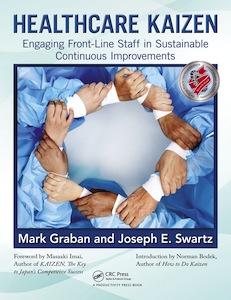
Table of Contents – Healthcare Kaizen
Full book description | Download TOC as PDF
Part I: What is Kaizen?
1) Intro to Kaizen
Introduces Kaizen as a continuous improvement model grounded in the Plan-Do-Study-Adjust (PDSA) cycle and the scientific method. The chapter emphasizes small, practical changes that engage people in improving their own work in ways that matter to patients and staff.
2) Kaizen History
Explores the evolution of employee suggestion systems in healthcare, highlighting the key differences between traditional “suggestion box” approaches and the more effective, systematic practices of Kaizen.
3) Types of Kaizen
Explains the three levels of Kaizen—strategic improvement, rapid improvement events, and daily Kaizen—adapted from Toyota. The chapter clarifies how Kaizen and Kaizen events are both grounded in PDSA and function as complementary parts of an integrated improvement system.
4) Kaizen Culture
Draws on the experiences of Franciscan St. Francis to describe what a Kaizen culture feels like for staff, leaders, and patients. The chapter explores the mindsets required to begin Kaizen and sustain it successfully over time.
Part II: Kaizen Methods
5) Quick and Easy Kaizen
Describes the method used at Franciscan St. Francis to encourage, document, and share Kaizen improvements, illustrated with real examples from multiple organizations. Introduces the “QnEK” model—find, discuss, implement, document, and share—focused on small improvements that can be implemented quickly and easily.
6) Visual Idea Boards
Explains practical methods for tracking and implementing improvement ideas, drawing on approaches described in Creating a Lean Culture and Lean Hospitals. Examples show how visual systems support follow-through and how managers can coach Kaizen effectively.
7) Sharing Kaizen
Presents different ways to document and share Kaizen improvements, including Kaizen Walls, A3 reports, and simple summaries. The chapter shows how visibility and recognition help spread effective ideas and encourage ongoing improvement.
Part III: Kaizen Lessons Learned
8) The Art of Kaizen
Examines common organizational “barriers to Kaizen” and reframes them as opportunities to better engage different groups of staff in continuous improvement.
9) The Role of Leaders in Kaizen
Clarifies the roles and actions of leaders at all levels—senior leaders, middle managers, and frontline managers—and explains how leaders actively participate in Kaizen by promoting, supporting, coaching, and sharing improvements.
10) Creating an Organization-Wide Kaizen Program
Explains how to design and sustain an organization-wide Kaizen program, using examples from Franciscan St. Francis and other hospitals. Includes practical guidance on reward systems and electronic methods for documenting and sharing Kaizen improvements.
11) Lean Methods for Kaizen
Explores how broader Lean improvement methods are integrated into Kaizen practice, based on staff education and real-world experience at Franciscan.
12) Kaizen at Home
Highlights how Kaizen principles extend beyond the workplace, featuring real examples from Franciscan staff and other healthcare professionals who apply continuous improvement in their daily lives.
Conclusion
Summarizes core Kaizen principles and reinforces the role of leadership, culture, and daily improvement in building a sustainable system of continuous improvement.
Book Summary | Google Books Preview
A comparison of Healthcare Kaizen and The Executive Guide and their chapters:
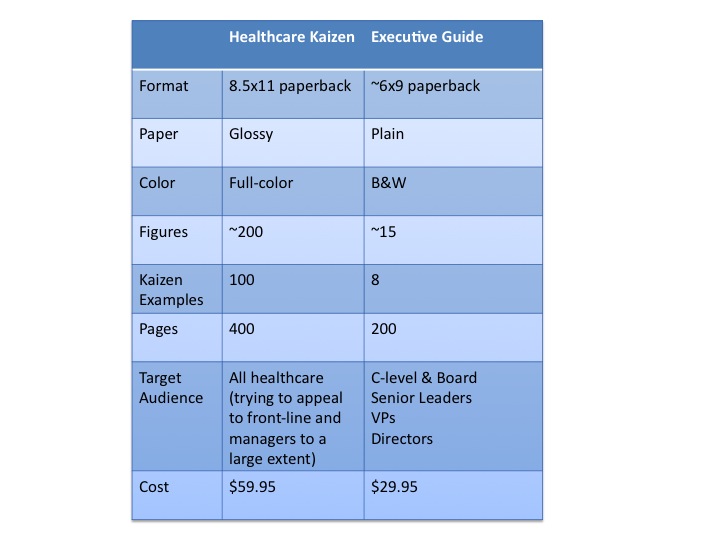
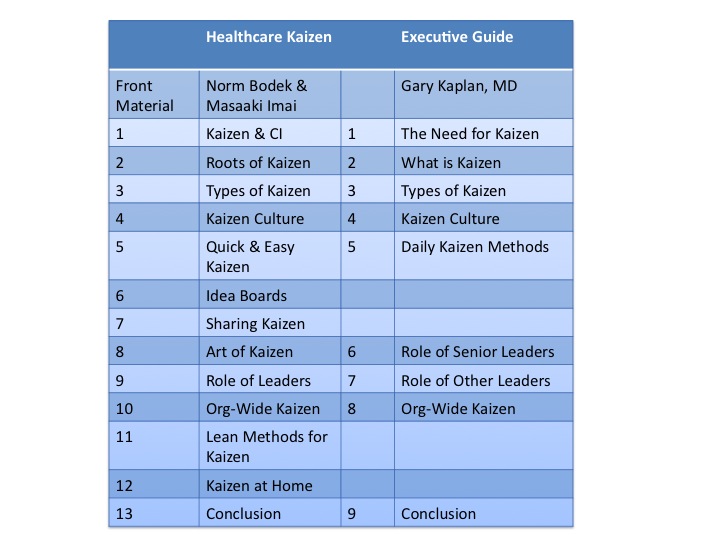
Together, these chapters reflect a practical, experience-based approach to Kaizen in healthcare—one that emphasizes daily improvement, leadership responsibility, and respect for the people doing the work. Healthcare Kaizen is designed to help organizations move beyond isolated projects toward a sustainable system of continuous improvement.
Readers who want a shorter, leadership-focused overview may also want to explore The Executive Guide to Healthcare Kaizen, which complements this book by focusing on the role of leaders in creating and sustaining a Kaizen culture.