
Executive Guide Contents
This page lists the full table of contents for The Executive Guide to Healthcare Kaizen. The chapters are designed for healthcare leaders and focus on leadership roles, culture, and systems needed to sustain continuous improvement across the organization.
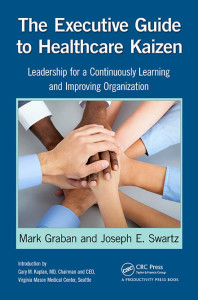
Table of Contents – Executive Guide
Full book description | Download TOC as a PDF
Chapter 1. Why Kaizen?
Explains why Kaizen and continuous improvement are critical for healthcare organizations facing increasing pressure on quality, safety, cost, and workforce morale. The chapter reframes improvement as a leadership responsibility and a strategic necessity, not a cost-cutting exercise.
Chapter 2. What Is Kaizen?
Introduces Kaizen as a system of daily continuous improvement rooted in respect for people and scientific thinking. The chapter clarifies what Kaizen is—and what it is not—helping leaders distinguish between true Kaizen and superficial improvement efforts.
Chapter 3. Kaizen and Lean Management
Describes how Kaizen fits within a broader Lean management system and why successful organizations view Kaizen as a core operating philosophy rather than a standalone program or set of tools.
Chapter 4. Creating a Culture of Continuous Improvement
Explores what a Kaizen culture looks like in practice and the conditions required to sustain it. The chapter emphasizes psychological safety, trust, and leadership behaviors that encourage people to speak up and improve their work every day.
Chapter 5. The Role of Senior Leaders
Clarifies the specific responsibilities of senior leaders in supporting Kaizen, including setting direction, modeling desired behaviors, and removing barriers. The chapter reinforces that leaders do not “delegate” Kaizen—they actively enable it.
Chapter 6. The Role of Managers
Examines how middle managers and frontline leaders support Kaizen through daily coaching, follow-up, and problem-solving. The chapter highlights the shift from managing people to developing people through improvement.
Chapter 7. Kaizen Methods at a High Level
Provides an executive-level overview of common Kaizen methods, including daily Kaizen and rapid improvement events, without diving into operational detail. The focus is on understanding purpose, alignment, and appropriate use—not mechanics.
Chapter 8. Measuring the Impact of Kaizen
Discusses how leaders should think about measuring Kaizen, including financial results, quality and safety outcomes, staff engagement, and learning. The chapter cautions against narrow ROI thinking and emphasizes long-term system performance.
Chapter 9. Rewards, Recognition, and Motivation
Explores how recognition and reward systems can either support or undermine a Kaizen culture. The chapter helps leaders avoid common pitfalls and design approaches that reinforce intrinsic motivation and continuous learning.
Chapter 10. Building and Sustaining a Kaizen Program
Brings together leadership, culture, and systems thinking to show how organizations can sustain Kaizen over time. Real-world examples illustrate how leaders maintain momentum, adapt as the organization grows, and avoid initiative fatigue.
A comparison of Healthcare Kaizen and The Executive Guide and their chapters:
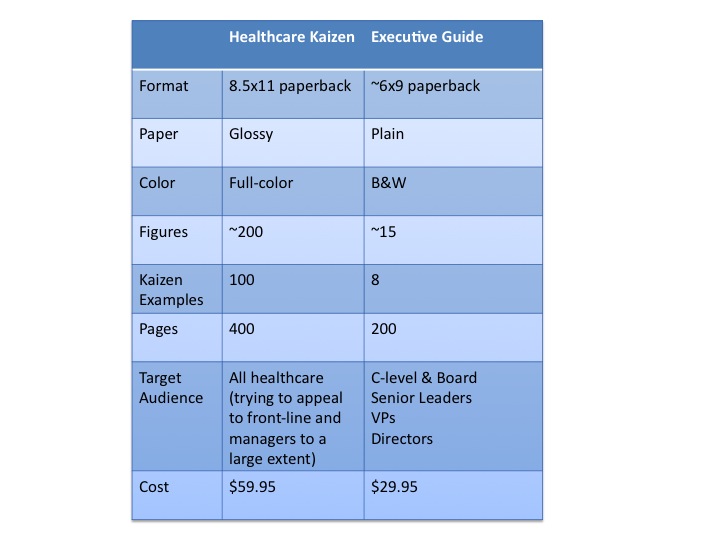
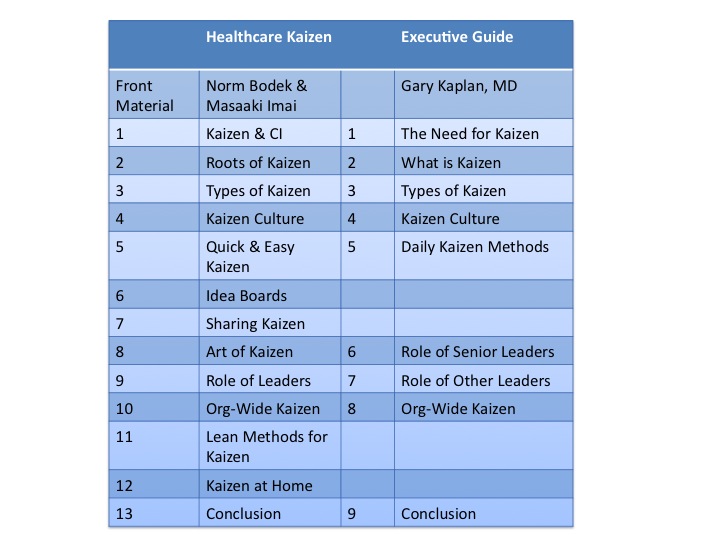
Taken together, these chapters focus on the leadership behaviors and management systems required to sustain continuous improvement. The book is intended to help leaders create the conditions for Kaizen to thrive across the organization.